Showing posts with label Spoiler-free. Show all posts

Saturday, February 18, 2023

Kiki's Delivery Service (1989)

My Internet connection has been spotty all day, so let's see if we can get this review posted.  If not, I'll just have to post it tomorrow.  But our Studio Ghibli film du jour is Kiki's Delivery Service (1989).

SYNOPSIS:
Kiki (Kirsten Dunst), a young witch, has just turned 13 and has to spend a year on her own, developing her skills as part of her apprenticeship.  But leaving home to live on her own is a scary concept, especially since her only skill is broom flying (and she can barely handle that).  Nonetheless, she sets off with her talkative black cat, Jiji (Phil Hartman), and sets up a flying delivery service in an oceanic town.

REVIEW:
This is one of my favorite Studio Ghibli films!  Like their last film, My Neighbor Totoro (1988), this is more of a day-in-the-life kind of story.  There's not a lot going on except for some added drama and tension at the very end.  Pretty much the whole film is following Kiki as she tries to get herself established in Koriko, a fictional oceanic city in Europe.

Hayao Miyazaki and his team of artists traveled to Sweden for scenic inspiration for this film.  As a matter of fact, a lot of street signs in the film are copied directly from streets in Stockholm, Sweden.  Miyazaki has claimed that this fictional city of Koriko is located between the Mediterranean and Baltic Sea.  It's set in the 1950s, in an alternate world where WWI and WWII never happened.  You definitely see the '50s aesthetic with the cars, trucks, and busses driving around the city.

Definitely a European city in the '50s.

From the moment Kiki arrives in town, she's greeted by a nosy boy named Tombo (Matthew Lawrence).  He's part of an aviation club and is fascinated with the young witch, to the point of being a bit rude (calling her "Miss Witch" instead of asking her name).  Kiki does her best to ignore him, but he's persistent, tracking her down in order to invite her out to his aviation club meetings.

Tombo coming off a bit aggressive in meeting a new girl.

Kiki gets exceptionally lucky, as she stumbles across a place to live and work within the first day she arrives.  She helps out Osono (Tress MacNeille), the owner of a bakery shop, who offers her a room to stay in.  In lieu of payment, she asks that Kiki watch the bakery every now and then.  She also helps Kiki get started in her delivery service by promoting her to customers.

A very pregnant Osono thanking Kiki.

Kiki's first delivery goes awry, as she drops the package in a forest.  But upon retrieving it, she meets Ursula (Janeane Garofalo) a young painter in a cabin whom she becomes close friends with.  On another delivery, she also befriends a Madam (Melanie MacQueen) and her housemate, Bertha (Edie McClurg).  They send a herring and pumpkin pie to the Madam's granddaughter for her birthday, but the granddaughter isn't very grateful, saying she hates her grandma's stupid pies.

Kiki helping out Madam and Bertha.

I love the contrast between Kiki and all the other kids she meets in this film.  She's always very polite and willing to go out of her way to help others, while all the other kids we see are more selfish and uncaring.  Not only the granddaughter, but there's a young boy who gets a gift delivered and shows little interest or gratitude.  Plus, Tombo (and his friends) is inadvertently rude to Kiki and he doesn't bother to learn her actual name until later in the film.

Meanwhile, Kiki refuses to be paid for a job she didn't work and offers to do chores around the person's house to earn her pay.  She's always overly nice and helpful with everyone.  Except Tombo, whom she keeps snubbing throughout the movie for no good reason.  I mean, he's a little bit too aggressive in talking with her from the start, but we find out later that he's actually a really kind guy, and as a member of an aviation club, he got a little over-excited at a real live witch who could fly on her own.

Just as Kiki and Tombo were becoming good friends though, she falls into a depression out of nowhere and snubs him once again.  She suddenly finds it impossible to fly anymore, and Jiji isn't able to talk to her.  He only meows and acts like a regular cat.  She fears she's losing her powers and ends up taking a vacation to visit her friend Ursula in the woods, to relax and decompress for a bit.

Ursula and Kiki having a sleepover at Ursula's cabin in the woods.

I won't spoil the ending, but it takes an extreme situation to help her snap out of her funk and get control of her powers once again.  An interesting note: in the original Japanese film, Jiji never speaks to Kiki ever again. Hayao Miyazaki said that once a witch grows up, she loses the ability to communicate with her cat, which is what apparently happened to Kiki.  But the Disney dub of this film made sure that Jiji spoke to Kiki again once she gets her powers back, as they felt it would be sad if she could never speak to her cat again.

Another sad fact: Disney hired Phil Hartman do the voice work for Jiji.  But he was sadly murdered in his sleep by his third wife in a murder-suicide.  He had just completed the dub work for this film when he died, and Disney dedicated their dubbed version to his memory.

RIP Phil Hartman.  You were the best Jiji.

RECOMMENDATION:
As I said previously, this is one of my favorite Studio Ghibli films.  It's such a fun story, and everyone is so nice throughout the film.  It truly espouses Hayao Miyazaki's vision of a better world.  I'd recommend everyone watch this at least once in their life.


Sunday, February 12, 2023

Castle in the Sky (1986)

Welcome to day 2 of my Studio Ghibli marathon!  Today we're looking at the first official film produced by Studio Ghibli: Castle in the Sky (1986).

SYNOPSIS:
A technologically-advanced castle named Laputa, which floats hidden in the clouds, becomes more than legend when an advanced robot falls to the ground one day.  In pursuit of the mythical castle in the sky, government agents, the military, and even sky pirates pursue a young orphan farm girl named Sheeta (Anna Paquin), who possesses a rare gemstone that can point the way to the fabled city!

REVIEW:
This film was originally released in Japan under the title Laputa: Castle in the Sky (1986), but its creator, Hayao Miyazaki, discovered later that "la puta" means "the whore" in Spanish.  Regretting the name choice, it was renamed Castle in the Sky (1986) for most of its international audiences.  Laputa is actually a floating island in Jonathan Swift's novel Gulliver's Travels, which inspired parts of this film.

For these Studio Ghibli films, I will be crediting the American voice cast in my reviews, as most of my readers are English-speaking and may not be familiar with the Japanese cast.  Besides, since Disney bought the rights for American distribution of Studio Ghibli films, they've always made sure to have a star-filled cast.

Some of the cast were just starting their careers in these early films too, like Anna Paquin (Sheeta) and James Van Der Beek (Pazu), who play the two main children.  But we also have some big names in the industry, like the return of Mark Hamill (Muska) and Tress MacNeille (Okami), as well as Jim Cummings (General), Cloris Leachman (Dola), and Andy Dick (Henri).

This film jumps right into the action, with a captured Sheeta being transported in an airship by government agents.  But then they're attacked by Dola and her sky pirates! Attempting to evade everyone, Sheeta climbs out a window and clings to the outside of the airship... until she slips and plummets into the night sky!

Pazu catching a floating Sheeta

But her stone jewel necklace heirloom begins to glow and she floats gently to the ground, where she's found by an orphan miner boy named Pazu.  With the government, military, and pirates on their heels, Pazu and Sheeta take off while the miner townsfolk attempt to distract their pursuers.  Sheeta is eventually recaptured and the location to Laputa is revealed! It becomes a mad race between the pirates, military, and government agents to reach Laputa before anyone else.

Pirate vs. Miner! Manly man contest! Who can flex through their shirt best? Who can take a gut punch?

As with most Studio Ghibli films, you can't make assumptions of anyone's character or intentions based on their first impression.  Dola and her sky pirates are initially seen as a dangerous threat to Sheeta and Pazu, but once the government agents get their hands on Sheeta, Pazu teams up with the pirates to help save her.  They end up befriending the pirates and we learn that Dola and her crew are actually good people.  They become strong allies who help Sheeta save Laputa from the corruption of the military.

Originally assumed to be a threat, Dola and the sky pirates end up being good friends and allies!

We do get a solid nonredeemable villain in this film in the form of Muska, which is rare for a Studio Ghibli film.  The government agent has his own agenda and is willing to do whatever it takes to gain control over Laputa.  Played by a young(er) Mark Hamill, I definitely caught a hint of his evil Joker voice sneaking out a bit when he laughed.  He played The Joker in Batman: The Animated Series (1992) for many years; it's probably his most famous acting role outside of playing Luke Skywalker in the original Star Wars trilogy.

Muska, holding Sheeta captive as a robot pursues them.

There were a lot of parallels between this film and Hayao Miyazaki's former film, Nausicaä of the Valley of the Wind (1984).  To name a few, Sheeta is revealed to be a princess who is taken hostage by the military, there's another royal member who is pursuing her for their own selfish reasons, and the ultimate goal of multiple parties is to claim an ultimate weapon that will make them the undisputed rulers of the world.  Also, we see a small gathering of fox squirrels on Laputa, exactly like Nausicaä's pet Teto.

Fox squirrels!  I want one!

Sheeta herself receives a ton of help and support from Pazu, as she's just an ordinary farm girl.  But she has her own independent strengths that help her throughout the film.  Both of her parents have passed away, so she's been tending a farm by herself and is completely self-reliant.  Despite being captured several times, she's not a damsel in distress, waiting to be saved.   She manages to escape on her own every time.  And even though she has no interest in Laputa or its history, power, technology, etc., she still feels a need to save it from the corrupt powers looking to take advantage of the advanced former civilization.  She and Pazu join the sky pirates to stop the military from taking over the floating castle.

This film takes place in an era of industrial revolution, as is evidenced when Pazu admires a motorcar that pulls up to his house.  Not to mention, the flying military zeppelin, the sky pirates' own small airship, and other more primitive forms of transportation like trains.  This film actually inspired a steampunk wave across anime (animated films/shows) and manga (comic books) for the next few decades.  A lot of Japanese steampunk media today can be traced back to this film.  Not that steampunk wasn't known prior, but it had a resurgence of popularity thanks to this film.

Older military weaponry and vehicles (like airships/zeppelins) make common appearances in many Studio Ghibli films, as Hayao Miyazaki is a fan of European WWII weaponry and machinery, despite his distaste for war.  The military is portrayed as a bunch of greedy, trigger-happy fools in this film.  As soon as they set foot on Laputa, they immediately start looting treasures and antiquities, haphazardly throwing them in a pile to be loaded onto their zeppelin.

I have to say, I have a minor fear of heights, but this film does everything in its power to set it off.  From the very beginning where Sheeta falls off an airship, to Pazu trying to climb on the crumbling vines covering the underside of the floating castle.  I definitely felt anxiety watching him climbing stone pillars that were collapsing and falling miles into the ocean below, right beneath him.  Not to mention, there are no guard rails anywhere on Laputa. So many narrow paths with nothing to keep you from falling... *shudder*

Quit goofing off on that ledge! You're giving me an anxiety attack!

RECOMMENDATION:
This early Studio Ghibli film gives you a taste of the steampunk/sci-fi/fantasy adventures to come in future films, while also leaning heavily on the original film that inspired the creation of the studio (Nausicaä of the Valley of the Wind (1984)).  It was a great start to Studio Ghibli's history, and a fun film for Studio Ghibli enthusiasts.  I definitely recommend it!


Saturday, February 11, 2023

Nausicaä of the Valley of the Wind (1984)

Surprise! I've been planning on doing a Studio Ghibli marathon for a while now, but life kind of got in the way.  But I'm currently recovering from knee surgery and am stuck on the couch for the next 3 months while it slowly heals, so I figured... why not kick off a movie marathon?  Starting with Studio Ghibli's first full-length feature film, Nausicaä of the Valley of the Wind (1984).

SYNOPSIS:
1,000 years into the future, humanity is living in a post-apocalyptic world in small pocket kingdoms.  Most of Earth is poisoned, covered in toxic spore-ridden forests full of dangerous building-sized insects. Nausicaä, the princess of the Valley of the Wind kingdom, has learned to live in harmony with the deadly forest and its creatures near their borders. But a war has broken out between two other nearby kingdoms, and the small, peaceful Valley of the Wind finds themselves caught up in the middle. Can Nausicaä quell the warring nations, save her people, and broker peace between humans and insects?

REVIEW:
This film is based on the first two volumes of Hayao Miyazaki's manga by the same name. It's important to note that, while this film is considered a Studio Ghibli film, it was actually released a year before Studio Ghibli was created. Hayao Miyazaki, along with Isao Takahata, Toshio Suzuki, and with funding from Yasuyoshi Tokuma (the founder of Tokuma Shoten), created the studio in 1985 to continue producing films in a similar vein to Nausicaä of the Valley of the Wind (1984).

Studio Ghibli's current official logo, inspired by their film My Neighbor Totoro (1988).

It's also important to note that, even though Hayao Miyazaki and Studio Ghibli are sometimes used interchangeably when it comes to certain genres of family-friendly anime films, not all Studio Ghibli films are works of Hayao Miyazaki, and vice versa.  This marathon will focus on the full-length feature films produced by Studio Ghibli itself, regardless of who might be in charge of the production; this first film being the sole exception since it inspired the studio's creation.

Hayao Miyazaki has strong anti-war and anti-industrialist views, having grown up watching forests, rivers, mountains - nature in general - be destroyed in the name of socioeconomic progress.  You will see a lot of his views reflected in his works.  He is a realist, tortured by the reality of the world and its evils within.  He uses his films as a sort of escapism, showcasing a world that can be better than the one we currently live in.  It's his hope that his animated worlds will inspire people to grow up better and with more love and care in their hearts toward others and the world we live in.

As such, you rarely see a solid good vs. evil story in a Studio Ghibli film.  Everyone, even the "bad guys," are typically relatable characters who usually have justifiable reasons for their actions.  This makes Studio Ghibli films very complex and emotional.  You're not just along for the ride, watching a good guy save the day, but you're bombarded with all sides of an issue and you're left to think for yourself about who is right and who is wrong.  And sometimes, you find yourself understanding or agreeing with the motivations of supposed antagonists.

Nausicaä of the Valley of the Wind (1984) is no exception.  It leans heavily into the man vs. nature themes, pointing out how humanity, in its greed and warmongering, destroyed the planet.  Our limited civilizations that remain are forced to live in isolated pockets that are less contaminated than the rest of the world, and are constantly fighting off the ever-growing toxic forests that are trying to claim the planet.

Nausicaä exploring the toxic forests.

Nausicaä herself is a bit of an outlier, choosing instead to explore the toxic forests and learn from them.  She's a pacifist, refusing to harm any living creature, and works hard to find a way for humans and insects to live in harmony.  She discovers that only the top layer of earth is contaminated, and that the forests and its plant life can grow safe and harmless if exposed to non-poisoned soil and water deep underground.

Nausicaä is a strong feminist icon, being a highly intelligent and respected leader of her kingdom who throws herself in harm's way to protect everyone, human and insect alike.  Despite being threatened and taken prisoner by a warmongering princess from another kingdom, she makes every effort to save the princess's life when things get hairy.  She's always the first person to step into the middle of conflict and attempt to resolve it without violence or intimidation.

Hayao Miyazaki has been celebrated for his strong positive female characters in his films.  There's no objectifying of women in his films, nor sidelining or disrespecting anyone based on gender.  He doesn't like to be called a feminist, instead believing that mutual respect across the board should be the base standard we all aspire to, not a labeled sect of our social structure. He also claims that women are more interesting to see in lead roles than men, which is why he has so many strong women protagonists in his films.

Nausicaä trying to save someone from a rampaging Ohmu by calming its rage.

Meanwhile, two nearby kingdoms end up fighting over an ultimate weapon from 1,000 years past - an unhatched pod bearing a "Giant Warrior," which is a massive bio-weapon used by ancient civilizations to conquer nations.  The conflict literally crash-lands on the shores of the Valley of the Wind, turning the peaceful nation into a war front.  Nausicaä is taken as leverage in the war and finds herself entangled between two destructive kingdoms, who are hell-bent on controlling the world-ending weapon and destroying the delicate but poisonous forests.

The Giant Warrior pod, incubating in the Valley of the Wind. Look at those menacing green eyes and massive teeth!

This film, when it released in America, got hacked up for American audiences. 22 minutes of footage was cut and the environmental message was removed.  Also a lot of the warring between nations was edited out and the giant insects (known as Ohmu) were made into the main antagonists.  The film was originally released in America under the title Warriors of the Wind (1985) and even changed characters' names.  The original message of the film was removed, instead turning it into an action/adventure tale for children about surviving rampaging giant insects.  It enraged Hayao Miyazaki so much that when Princess Mononoke (1997) was set to release in America, he personally sent a katana (Japanese curved sword) to Harvey Weinstein, with a letter that read, "NO CUTS!"

Hayao Miyazaki, on his way to threaten Harvey Weinstein.

Fortunately, when Disney bought the rights to Nausicaä of the Valley of the Wind (1984), they released a full, unedited version in 2005 with a new star-studded English voice cast, including talents such as Patrick Stewart (Lord Yupa), Mark Hamill (Mayor of Pejite), Tress MacNeille (Obaba), Uma Thurman (Kushana), and Shia LeBeouf (Asbel).

Apparently, I've only seen the old American cut from the '80s, because I was surprised at all the additional story included in the film during this recent viewing.  I'm watching the full film for the first time today!  I remember this film being kind of slow and boring, but with all this additional story, it actually flowed much better, with a much more entertaining plot.

RECOMMENDATION:
This is a classic story about respecting nature and all its creatures.  It's a little darker than the average Studio Ghibli film, and despite Nausicaä's pacifism, there are plenty of PG deaths portrayed.  Even Nausicaä gets a few kills in when she flies into a rage, which she later regrets.  The film doesn't shy away from the horrors of war, but does censor it enough for most audiences to enjoy it without trauma.  This was a great start to Hayao Miyazaki's independent filmmaking career, and I highly recommend you find the 2005 Disney remaster if you plan to watch it.  Or the original Japanese language film, if you prefer to watch it as it was originally released (as is my personal preference).


Thursday, October 13, 2022

Werewolf by Night (2022)

Marvel Studios surprised us all with a sudden release of their very first TV special, Werewolf by Night (2022).  I had never heard of it until it was suddenly available for streaming on Disney+, but it was apparently a Marvel comic series that's been running since 1972.  Let's discuss it!

SYNOPSIS:
Monster hunters from all across the globe gather at Bloodstone Temple to honor the recently deceased Ulysses Bloodstone, their former leader.  His ultimate weapon which bears his namesake, the Bloodstone, is up for grabs and his widow has prepared a deadly monster hunt to determine who will earn the right to wield the powerful weapon.

REVIEW:
This TV special is visually stunning! With black-and-white film, spooky music, and a ton of practical effects, it successfully mimics the Universal Monsters horror film genre popular in the 30s and 40s.  Even Werewolf by Night himself looks similar to The Wolfman (1966) in appearance.  They went (mostly) practical effects on the werewolf make-up instead of giving him a CGI body like The Hulk.

Werewolf by Night, in all his horror film glory
Oh yeah - that's his actual comic book superhero name: Werewolf by Night.  His alter ego, Jack Russell (Gael García Bernal), is a timid man who has an impressive monster kill tally.  He joins the hunt for his own personal reasons.

The comic book version of Jack Russell was born with the curse of lycanthropy, inherited by an ancestor who was bitten by a werewolf in 1795.  Interestingly, it was his father who activated the werewolf curse by reading about it in the Darkhold, a powerful and evil magic book.  We actually saw the Darkhold in Doctor Strange in the Multiverse of Madness (2022), earlier this year. Do we now have a movie connection between Marvel's new horror monsters and the previously seen Darkhold?  Only time will tell...

Also joining the hunt is Elsa Bloodstone (Laura Donnelly), who is the estranged daughter of Ulysses Bloodstone.  She disagrees with the monster hunter's lifestyle and wishes to claim her (forfeited) inheritance from her stepmother so that she can disband the monster hunters once and for all.

She spends the film being tired of dealing with people, being a badass assassin, or scared for her life.  In an age of female empowerment, it's rare to see lead women scared on screen anymore, for fear of angering progressives.  But she managed to pull off the badass hunter vibe, while also being genuinely scared when her life was in danger.  It added a touch of realism to her character, which I appreciated.  Who wouldn't be terrified for their life when trapped and outmatched by a giant monster?  It also calls back to the days of the Universal Monsters, when women were essentially pretty damsels in distress and constantly fearful for their lives. Granted, Elsa is no damsel in distress and proves she can take care of herself, but it adds to the vintage tone of the film to see her scared and a bit vulnerable when confronted with actual monsters.
Elsa Bloodstone, tired of everyone's shit

We also get a small appearance of a monster familiar to long-time Marvel comic book readers: Man-Thing (Carey Jones for motion capture; Jeffrey Ford for voice).  He's an empathetic swamp monster who normally lives in the Florida Everglades, but he finds himself mixed up with the monster hunters. Despite his well-known monster name, in this special he actually goes by his former human name, Ted.

In the comics, he was originally the biochemist Dr. Theodore "Ted" Sallis, of Omaha, Nebraska. He was in the Florida Everglades, researching the development of a new super soldier serum like the one that created Captain America, but found himself running from the technological terrorist organization A.I.M.  Attempting to evade them, he injected himself with the only sample of his serum.  But while he was on the run, he crashed his car into a swamp, where the scientific chemicals in his blood and the magical properties of the swamp transformed him into the giant, lumbering Man-Thing!  Ted's mind was forever lost in that swamp, but the mentally-stunted monster manages to periodically find himself saving the day, sometimes alongside the Avengers themselves.

Man-Thing, making his live-action Marvel Cinematic Universe debut!
The Bloodstone itself gets the honor of being the only color in this film, casting an eerie red glow among the black-and-white scenes.  Near the end of the TV special, we hear Over the Rainbow, sung by Judy Garland, playing as the black-and-white film slowly turns to color.  A very lovely tribute to The Wizard of Oz (1939), a classic film of the same black-and-white era that surprised audiences by changing into a full color spectrum when Dorothy woke up in Oz.
The vibrant red Bloodstone, stealing the scene
RECOMMENDATION:
At 53 minutes, this short film was a brilliant introduction to the Marvel Cinematic Universe's horror genre.  Hopefully it will spawn more monsters and creatures of the night, further expanding the world of the MCU.  We saw Sony fail to introduce Marvel's monsters with the film Morbius, which has become a running joke on the Internet.  But the MCU managed to pull off a vintage-inspired short story, teasing audiences with the darker realm of Marvel and leaving us begging for more.  Surprisingly, this special dodged the TV-MA rating, due to the black-and-white film obscuring the more visceral scenes.  So watch it along with your older children, but you might want to put the young kiddos to bed before putting this on.


Tuesday, October 4, 2022

Don't Hug Me I'm Scared (2011)

I said I wasn't planning to do a daily Halloween Month Movie Marathon™, but I came across something today that I felt needed a review.  Prepare yourselves for the horrifying YouTube series called Don't Hug Me I'm Scared (2011).

SYNOPSIS:
Don't Hug Me I'm Scared (2011) is a short educational British children's show, only airing six episodes at 3-1/2 to 8 minutes per episode.  Each episode teaches about a fun concept, like being creative, time, healthy eating, etc. But each episode turns dark at some point, changing from a fun, bright kid's program into psychological horror.  What exactly is this show about...?

REVIEW:
If you haven't watched this show yet, I highly recommend you do.  Like, right now, before you read further.  It's so short, you can burn through all of it in about a half hour.  You can find it on YouTube, where it originally aired.  You only need to watch episodes 1-6; the other videos are teasers for episodes, with their first video being an odd unrelated short about "Bad Things That Could Happen."

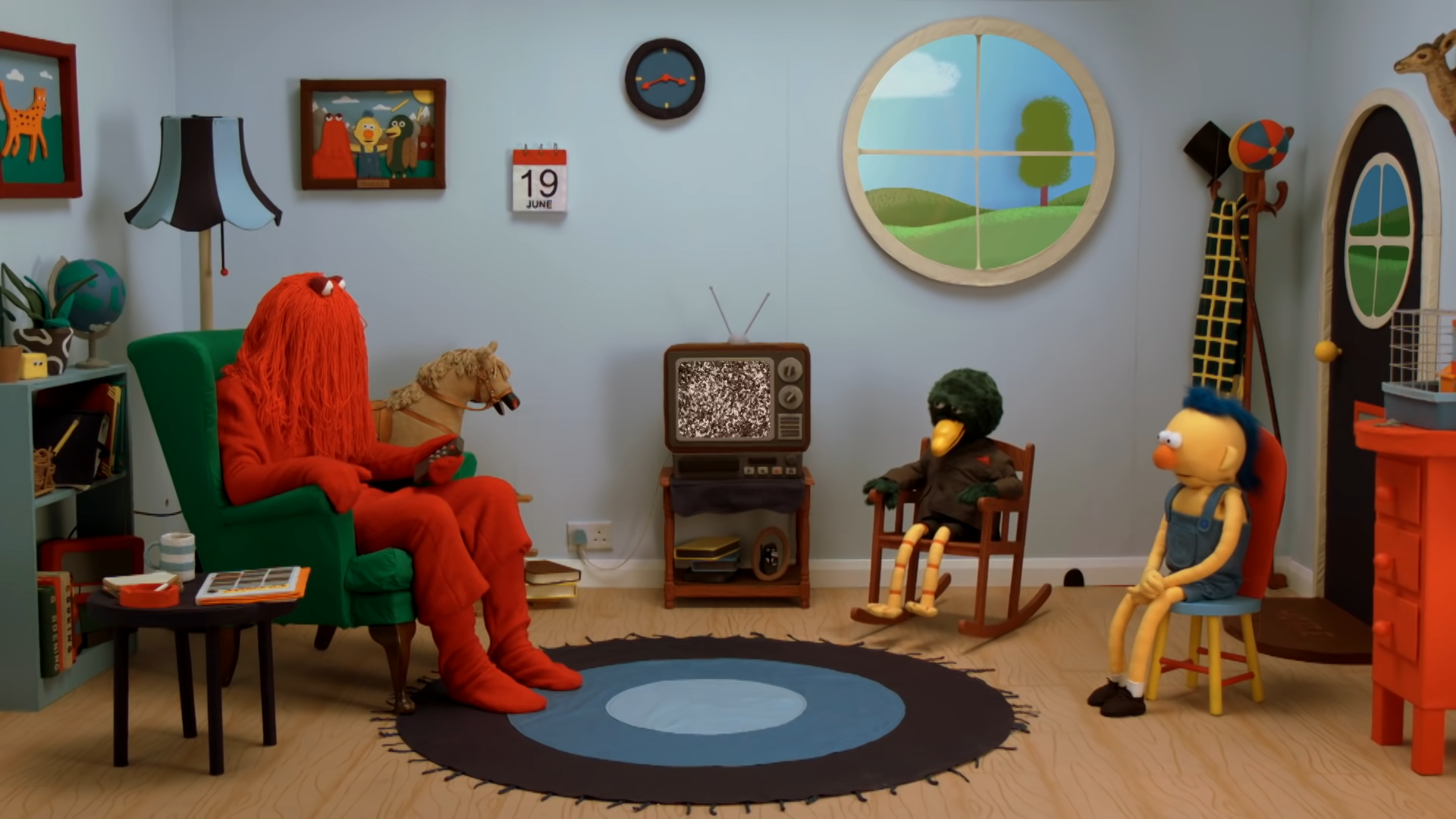
Red Guy, Duck Guy, and Yellow Guy, waiting for their favorite show to air
The show depicts three puppets: Red Guy, Yellow Guy, and Duck Guy.  Throughout the series, they explore different educational concepts that always end with a dark twist.  Red Guy, losing faith in the show, disappears after episode 4 and Duck Guy, terrified of the new direction the show takes, tries to leave in episode 5, leaving Yellow Guy to have an existential crisis by himself in episode 6.
Yellow Guy drowning after his bed turned into a pool of oil. Symbolic? Literal? I can't tell anymore.
Meanwhile, Red Guy wakes up in the "real world" and experiences humiliation at work and on a stage show, while Roy (Yellow Guy's creepy father) watches him from the shadows.
Red Guy at work in the real world... in widescreen aspect all of a sudden.
So... what's the point of this show?  What exactly is going on in each episode?  This has been an ongoing discussion with fans for many years now.  And the creators aren't helpful, claiming that they've read a ton of fan theories, and "all theories are correct."  Well, as it turns out, the creators believe in art as a personal experience; that is to say, whatever your interpretation of art is, is the correct interpretation. So if they have a point behind their show, it's inconsequential.

This leaves fans to come up with their own theories about the horrors going on within the show, and even behind the scenes.  The Film Theorist, in a 2-part video (part 1 here and part 2 here), has crafted the most popular theory on this show: that it's all a children's show created by Red Guy and sponsored by Roy.  He goes on to claim that the overall series is a critique of children's shows, telling kids to be creative, but only within certain parameters.  They brainwash children into conforming to certain educational boundaries and discouraging any true creativity, held down by sponsors who want to push their own vision to earn revenue.
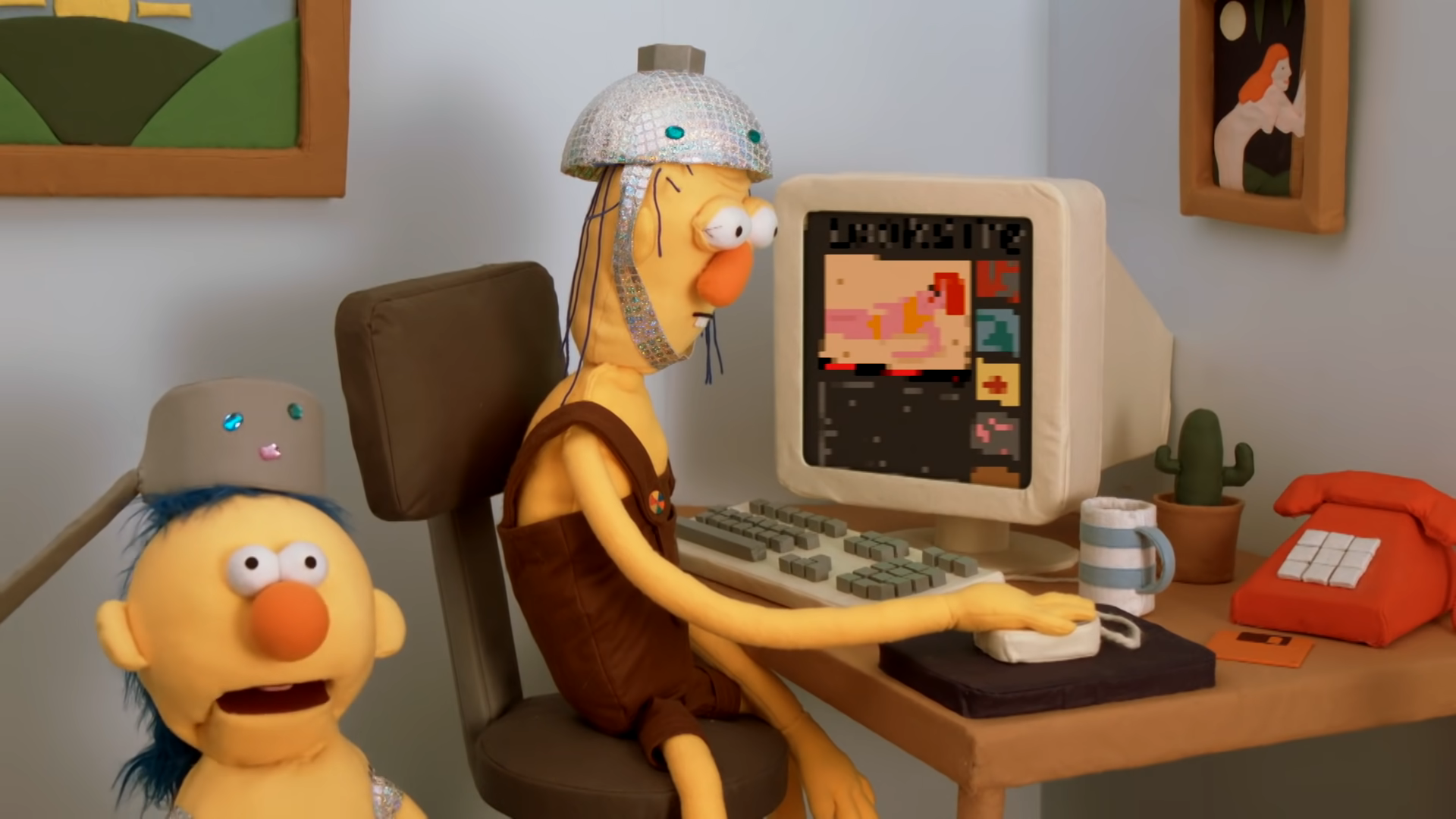
Roy watching porn as his son, Yellow Guy, sings and dances about it
However, as popular as this theory is, it forgets that the creators themselves have been trying to make a sponsored TV show out of this YouTube short.  As a matter of fact, they finally got their wish, and as of September 23rd, 2022, season 2 aired exclusively on Channel 4, a British streaming service.  It's also only six episodes, but this time, they're half-hour episodes with a full production budget.  I have not seen them yet, so maybe more clues as to what's going on with this show will be shown.

One of my favorite theories is that the whole show is Red Guy's attempt to hold onto his childhood as he's approaching adulthood.  He's the only adult-sized character on the felt-covered "show," but when he wakes up in the real world in episode 6, all the adults look like him and everything is tangible and real, not felt or crafted.  Or animated either.  When he goes on stage to perform with his puppet versions of the show's cast members, a guy comments on how rude he is for being naked on the stage.  But he's wearing the same outfit as his show, while all the other "red guys" wear normal adult clothing. Ever since he left the show, the remaining characters struggle to hold onto their reality as it slowly crumbles, perhaps showing his childhood slowly being forgotten and discarded.
Duck Guy being consumed by a giant can of food. Symbolism for mindless consumerism? I have no idea anymore.
There's a recurring date throughout the show (June 19th), which could be seen as Red Guy's birthday.  The date doesn't change until the end of the show, when he also changes.  As a matter of fact, all the characters change then.  So perhaps it's symbolic of him accepting adulthood and learning to let go of his childhood.  But the next season that just released shows the original cast, with no changes.  So... I guess we'll get more clues in the next series.
Be creative!
RECOMMENDATION:
If you love shows that acknowledge the existential dread in our lives, or perhaps you enjoy a dark psychological thriller with no true meaning, you should check out this web series. Hopefully the new season will reveal more of this dark world, adding or changing current theories about it.  Meanwhile, this show is very re-watchable, because there are so many creepy details hidden in the background for you to discover.  You should definitely check it out!


Sunday, October 2, 2022

Hocus Pocus (1993)

Hey all!  It's been a long time since I posted a film review.  I was scheduled to retire from the US Air Force in July 2022, so my life got very busy last year in preparation.  I meant to do a full Spider-Man film marathon, leading up to the climactic Spider-Man: No Way Home (2021).  But even though I did marathon all those films with my wife, I didn't have the energy to review every single one.  So it's on hiatus for now and I'll get back to it eventually.  You'll just have to live with the Tobey Maguire Spider-Man trilogy reviews for now.

But October is here, which means... Halloween Month Movie Marathon!!  I probably won't be reviewing films daily, but I do plan to write as many reviews as I can this month.  First up on the docket: Hocus Pocus (1993)!

SYNOPSIS:
On October 31st, 1693 in Salem, Massachusetts, three witches known as the Sanderson Sisters were hung for the crime of witchcraft.  Before they died, they uttered a curse, ensuring they would return one day.  Exactly 300 years later, Max (Omri Katz), a kid from LA, moves to Salem with his little sister, Dani (Thora Birch), and as a skeptic of witchcraft, Max asks his classmate, Allison (Vinessa Shaw), to show them the old Sanderson house on Halloween night.  While exploring the house, Max accidentally resurrects the three witches!  The kids have to find a way to stop the sisters, before they capture all the children of Salem!

REVIEW:
This film originally released to mediocre reviews and low box-office earnings, but subsequent replays during the Halloween season has slowly made it into a cult classic.  The screenplay was actually sold to Disney back in 1984 (and was a much darker tale), but they sat on it for 8 years before finally deciding to make a family-friendly film of it.

Still, there's something haunting for me about the mortality this film plays with.  Here are three witches who were attempting to brew a potion that would make them immortal.  Instead, they end up being captured and hung by an angry mob.  But they find a way to return to life for a single night, in which they need to recreate their immortality potion or else they'll turn to dust at dawn.  There's a scene later in the film where the witches believe they've failed and they accept that their one shot at life is over.  They cry and mope about their home, waiting for the end to come.  The hopelessness, even hammed up for comedic effect, still stung a bit for me.  I could feel their pain and anguish at losing.  They had only a few hours left to contemplate their own mortality before returning to oblivion, and I truly felt it.  I was kind of hoping they'd find a way to live on regardless, even though they were the villains.

On top of that, they "curse" a boy with immortality (ironic, I know), but he must live out eternity as a black cat.  I wondered why they didn't just use that curse on themselves instead of the complicated potion that requires child sacrifice, but I guess the curse came with shape-shifting, and they wanted to keep their human forms.

You can tell that the three actresses had fun in their witch roles.  Winifred (Bette Midler), Mary (Kathy Najimy), and Sarah (Sarah Jessica Parker) were the most energetic and entertaining parts of this film. Halfway in, I forgot I was supposed to be rooting for the kids; I was having so much fun watching the three Sanderson Sisters exploring the modern world that I kind of started rooting for them.  Until I remembered their plan was to consume the life force of all the children of Salem.  Oops.

The Sanderson Sisters, putting a spell on you!
My wife and I agreed that the scenes with Max and his little sister, Dani, were super cringey.  It was hard to watch them sometimes.  Mostly, it was Dani, who would run her mouth and say super embarrassing things to everyone.  But she's like 7 years old, so that's kind of expected.  Max's most cringe-worthy scene was actually near the beginning, when he talks shit about the Sanderson Sisters story in school, then when Allison corrects him, he walks up to her and gives her his phone number.  Right in the middle of class, in front of everyone.  Dude!  Not the time nor place.  She played it pretty chill though, taking his number, then later giving it back to him.

Kid sisters are super cringey and embarrassing. I know; I had one!
There was a little subplot with a couple bullies who harass Max and steal his shoes.  They made several appearances throughout the film, but I felt like their story never really went anywhere, except to exact some bully revenge near the end, when they're captured and caged by the Sanderson Sisters.

Some interesting related trivia: there was a sequel book written in 2018 that revealed that the two bullies straightened out their lives after running into the witches.  One became the principal of the local high school, while the other became a park ranger, hoping to rescue lost and trapped people, since he had experienced it first-hand as a teenager.  So they actually got a bit of a redemption arc, which is awesome!  That's a good story to tell!  I wish they had included something like that in the film.  But this was the early '90s, where the only story resolution that mattered was the main characters'.

Jay and Ernie, the two bullies, get a redemption arc in the book sequel!
Some more interesting trivia: Sarah Jessica Parker found out in the mid 2000s that her 10th great-grandmother, Esther Elwell, was accused of witchcraft in Salem, MA in the late 1600s.  Her case never went to court, and the accusation ended the Salem Witch Trials.  So she has some personal ties to the Salem Witch Trials, and is closer to being considered a real witch than any of the other actors.

Billy Butcherson (Doug Jones), is a zombie resurrected by Winifred to hunt down the main children. I never realized it until this viewing, but his back story is that he dated Winifred, until her sister, Sarah seduced him.  As punishment, Winifred poisoned him and sewed his mouth shut so he couldn't tell any secrets, even in death.  If you look closely, the stitching across his mouth is sewn in the shape of XIII, or the roman number 13.  You may not recognize his actor, Doug Jones, but he does a lot of famous creature work in films.  He also plays Abe Sapien in the Hellboy films, the amphibian man in The Shape of Water, and Fauno and the Pale Man in Pan's Labyrinth, to name a few.

Billy Butcherson, freshly resurrected
There was also the curious case of Thackery Binx (Sean Murray/Jason Marsden).  He was a boy from 1693 who was cursed by the witches to live immortal as a black cat, and he helps the children fight back against the witches.  They had an actor, Sean Murray, play his human role.  But they cast Jason Marsden to do all the voice work, both for his human and cat forms.  I guess they wanted a more accurate voice for the time period Binx comes from, but had a different face in mind for the actual actor.

The cat's head while he's talking was all CGI, and for 1993, it was excellent work!  I read that it was even more realistic originally, but the studio decided it was too real and might scare children, so they had to soften up his features and make the cat's fangs smaller and more rounded.  I would've loved to see their original CGI effects.

Amazing CGI for the early '90s!
This film also had some excellent original music, including the fun I Put a Spell On You and the haunting lullaby Come Little Children.  It's rare that a film will have a song so good that I add it to a playlist, but this film has two!  You should search them out on YouTube for a listen.

Maybe my only true negative critique of this film (besides the cringey interactions of the main children) is that the kids spend an inordinate amount of time running around town, trying to convince adults that the Sanderson Sisters are back.  It's Halloween night, in a town that (in this movie universe) is famous for the urban legend of the Sanderson Sisters.  Did you really think anyone would believe you?  It just feels like wasted time that could've been spent coming up with a solution for the problem. But I guess they gotta pad that runtime somehow...

RECOMMENDATION:
This film is so much fun to watch! It could've just been a film about resurrected witches hunting kids, but they decided to add in several scenes with just the Sanderson Sisters discovering the modern world.  Learning about paved roads, grasping the concept of a city bus, figuring out electronic devices... they were truly out of place in the modern world and there were so many scenes of learning and discovery that really makes this film enjoyable to watch.  I would hope that you've seen this film by now, but if you haven't, it needs to be on your bucket list!

Now if you'll excuse me, I'm off to see Hocus Pocus 2 (2022), which just released a couple days ago.  Hopefully it lives up to the energy and spectacle of the first film.  Expect my review of it tomorrow!

Sunday, December 19, 2021

Spider-Man (2002)

Hey! I'm back with another (relatively brief) movie marathon to finish out this year!  With the just-released Spider-Man: No Way Home (2021) film supposedly combining the Sam Raimi Spider-Man trilogy and the Amazing Spider-Man duology with the current Marvel Cinematic Universe (MCU) Spider-Man, I felt it was time to binge the old movies to refresh my memory of their story.  I will be binging ALL the modern films.  The Spider-Man trilogy, the Amazing Spider-Man duology, the Into the Spider-Verse animated film, and the current MCU Spider-Man Home trilogy.  Today, we're starting out with the film that made the superhero genre of films popular: Spider-Man (2002).

SYNOPSIS:
Peter Parker, a high school nerd from Queens, New York, is bit by a radioactive spider on a class field trip and develops amazing spider-like powers!  He can crawl walls, he can shoot webbing from his wrists, he has super-human strength and agility, and most importantly, he develops a "spider-sense" that warns him of incoming danger.  When Peter's uncle is murdered by a robber that he let get away, Peter is wracked with guilt.  He remembers the wise words his uncle left him with: "With great power comes great responsibility."  Peter takes it to heart and turns superhero, defending the citizens of New York from criminals.  But a powerful supervillain has also just arisen in New York... a science experiment gone wrong that creates the Green Goblin!  Spider-Man has to save New York from this dangerous menace!

REVIEW:
This film released at the beginning of the new century, so it was still trailing off the old '90s action films.  As such, the action is a bit cheesy and it has quite a few cringey dialogue moments.  Still, as a superhero film, I think it held up pretty well over the years.

This first Spider-Man film takes its origin story directly from the very first Spider-Man short story in the Marvel comic Amazing Fantasy #15.  Released in 1962, it tells of how a high schooler received spider powers, uses them for gain in boxing matches, then lets a robber escape, thinking it's not his problem, only to lose his uncle to the same man.  He chases down the crook and captures him for the police, but decides to take his uncle's lesson to heart and only use his powers responsibly.  The Green Goblin does not appear in the comics until The Amazing Spider-Man #14 (1964).  He was added to this film to give Spider-Man a supervillain to fight, as a simple story about learning responsibility was probably not appealing enough for the big screen.

I like Tobey Maguire and Kirsten Dunst, but I personally felt they were terrible for the roles of Peter Parker/Spider-Man and Mary Jane Watson.  Tobey Maguire has always been very awkward in all his roles and I cringe every time he needs to have a conversation with someone.  His creepy, silent, wide-eyed stare makes me feel very uncomfortable and I hate seeing him trying to interact with people when he's not wearing his Spider-Man outfit.  This, unfortunately, did not improve with his later Spider-Man movies.  In this role as Peter Parker, it kind of works because Peter is supposed to be an awkward teenager, but being Spider-Man is supposed to improve his confidence and he's able to verbally spar with his enemies while fighting them.  Tobey Maguire's Spider-Man still sounds like an awkward teenager throughout the whole film, mask or not.

Kirsten Dunst always seems to have this tortured, broken look on her face, even when she's smiling.  She's mastered the art of the cold, dead eyes, absent of soul and warmth.  She's great in drama films, but in a family action/adventure film, she seems out of place.  Mary Jane Watson from the Spider-Man comics is a very popular, outgoing, energetic person.  The polar opposite of wimpy Peter Parker.  But film Mary Jane comes from a broken home, dates bullies, fails to go anywhere with her life, and is all-around a miserable person.  I feel like they were trying to make her relatable and realistic, but it just doesn't feel true to her original character.  Honestly, I don't think Mary Jane has ever been portrayed accurately on screen.

If there's anyone who nailed their character, it's J. K. Simmons, playing J. Jonah, Jameson, the head of the Daily Bugle newspaper.  He's loud-mouthed, fast-talking, talks over people, and makes demands of everyone.  He has an important business to run, and he does it well.  Stan Lee originally wanted to play the character, as he said J. Jonah Jameson basically mirrored his personality in his young Marvel days.  But he was proud of the way J. K. Simmons managed the role.  And Stan Lee got his first very small cameo - before it became an obvious nod in the Marvel films - rescuing a child from falling debris.

Another excellent casting was Willem Dafoe as Dr. Norman Osborn/Green Goblin.  He was absolutely brilliant!  He was super creepy in the role, but I think that just enhanced it even more.  It's too bad they used a goblin helmet for his suit. The original Green Goblin from the comics wore a rubber mask that made him look like an actual goblin, and Willem Dafoe could have used that to dial his character up to 11 (not that he doesn't try anyway).  If there's anyone I can't wait to see in the latest MCU Spider-Man film, it's the Green Goblin played by Willem Dafoe.  They teased his presence in the trailers, which has me super excited!

Danny Elfman did the score for this film, which became the running theme for this live-action trilogy.  As the film was starting though, I got serious Batman vibes.  The music was very similar to the soundtrack he scored for the Tim Burton Batman films in the late '80s/early '90s.  But it had its own unique flair to it that makes it recognizable as Spider-Man.  We did not hear the familiar Spider-Man theme from the classic 1967 Spider-Man cartoon TV series, but there is a scene with a street performer singing his own Spider-Man song that has some familiar lyrics.

Sam Raimi directed this original trilogy of films.  He's well known for his other trilogy, the Evil Dead films (Evil Dead (1981), Evil Dead 2 (1987), and Army of Darkness (1992)).  He is close friends with Bruce Campbell, the star of that trilogy, so he got Bruce a cameo in his Spider-Man trilogy.  In this first film, you see him as the announcer at the boxing match - the guy who messes up "The Human Spider's" name and instead names him "Spider-Man."

RECOMMENDATION:
This is a classic superhero origin story that created the modern day superhero genre. We have this film to thank for every superhero film we've seen in the past 2 decades.  It may be from another generation and it might be a bit cringey and campy, but despite it all, it stood the test of time pretty well.  Spider-Man has always been my favorite Marvel character, so seeing him on the big screen was a dream come true, and I'm glad he has continued to grace the screen in one form or another these past couple decades.  This is a must-watch for all superhero enthusiasts out there.


Sunday, October 3, 2021

The Mummy (1999)

Happy Halloween month, everyone!  I don't have the energy this year to do a full Halloween movie marathon, but I do plan to watch and review some films this month.  Starting with a classic: The Mummy (1999)!  I've reviewed the Tom Cruise version of The Mummy (2017) and I've reviewed the original Universal Studios monster film The Mummy (1932). But somehow I've missed the classic '90s action/adventure remake of the classic.

SYNOPSIS:
In 1926 Egypt, a librarian named Evelyn; A.K.A. Evie (Rachel Weisz) and her sticky-fingered brother, Jonathan (John Hannah) stumble across a map leading to Hamunaptra, the lost "City of the Dead."  Expecting the archaeological find of the century, they recruit Rick O'Connell (Brendan Fraser), a man who claims to have been to the lost city, as their guide.  But during their expedition, they accidentally awaken the 3,000-yr old mummy Imhotep (Arnold Vosloo), a very powerful immortal creature who brings the plagues back to Earth.  Rick, Evie, and Jonathan must find a way to end the mummy's curse before he regains his strength and brings devastation to the world.

REVIEW:
This film is absolutely wonderful, expertly combining so many genres in an enjoyable way.  There's action/adventure, romance, comedy, and a touch of horror, all wrapped up nicely in a family-fun package.  All of the characters are well-written and play off each other so well.  You would expect Jonathan to be the bumbling comedic foil, but despite his comedic antics, he's actually very intelligent and slick, and helps to save the day more than once.  Evie is a brilliant librarian with an amazing knowledge of history and archaeological studies.  She may be a bit clumsy/ditzy at times, but she's rarely a damsel in distress, despite Rick trying to treat her as one.  Even Rick is surprised at times when she's able to hold her own.

Rick is our swashbuckling hero, jumping into more than he can handle and half the time escaping death by pure luck.  He does not have a heart of gold; rather, he's more of a gold-seeker, pursuing archeological finds for what treasure he can collect.  But when the chips are down, he always does the right thing.  When the mummy is released, his first instinct is to pack up and get out of town.  But when Evie is in danger, he abandons everything to seek her out and protect her.

A former friend of Rick's named Beni (Kevin J. O'Connor) fills the role of the sleazy coward, taking the easy way out every chance he can.  He holds no loyalties to anyone but his own, abandoning others to save his own skin wherever possible.  From the first moment he's on screen to the last, he's only thinking of himself and how to best to protect his own selfish interests. There's never been a more pathetic, punchable character in film that I can think of.  He's the type you love to hate and I enjoy every scene he's in.

Imhotep is probably the most tragic of the characters.  Despite playing the villain of the film, he's actually a former high priest of the dead who fell in love with the pharaoh Seti's mistress, Anck Su Namun (Patricia Velasquez).  In a plot to be with her, the two murder the pharaoh and then Anck Su Namun kills herself, expecting Imhotep to resurrect her so they could be together again.  But the pharaoh's bodyguards stopped the ritual, instead condemning Imhotep to the darkest curse they knew.  Upon resurrection, Imhotep's goal to resurrect his love becomes his primary focus and he's only the villain because of the extremes he's willing to go in order to complete that ritual.  It's very "Romeo and Juliet."  Two lovers forced to spend eternity apart.

Some interesting trivia: In the original 1932 Mummy film, Imhotep takes on the name Ardath Bay to blend in with other mortals.  In this 1999 Mummy film, "Ardeth" Bay (slightly different spelling, to become an anagram for "Death by Ra") is a separate character, the leader of the Medjai who watch over and protect Hamunaptra to ensure the mummy stays dead.

RECOMMENDATION:
I cannot recommend this film enough!  It's the perfect blend of family-fun action, adventure, fantasy, comedy, and romance.  The story keeps you well engaged and the characters are fun to watch.  This is truly the best Mummy film out there, and one of my favorite Brendan Fraser roles.  It's also my wife's favorite film of all time, and she has a habit of re-watching it several times a week. She never gets sick of it!

If you plan to watch the sequels, I'd recommend seeing The Mummy Returns (2001) and The Scorpion King (2002).  And nothing else.  The third Mummy film (The Mummy: Tomb of the Dragon Emperor (2008)) falls flat. They replace Evie's actress, Rachel Weisz, with Maria Bello, who does a generic "British clumsy girl in distress" role.  She had absolutely no chemistry with Brendan Fraser's Rick O'Connell and just made the film uninteresting to watch. Not to mention, the plot felt very forced.  Not creative and fun like the other films, but just going through the motions.  Also, there are 4 straight-to-video sequels for The Scorpion King.  They're pretty low quality and not really worth checking out.  Although Dwayne Johnson is producing a remake of The Scorpion King right now, so keep your eyes peeled for that.  No word on if he'll be reprising his role as the Scorpion King himself or if he's just producing/directing.


Saturday, July 31, 2021

Fear Street, Part One: 1994 (2021)

Boy, it's been a over a year since I did a review!  But my wife and I just watched the Fear Street trilogy on Netflix and it was so good, I felt I needed to talk about it.  I will post a review for each film, one a day, so come back tomorrow for the sequel! But today, we're checking out Fear Street, Part One: 1994 (2021).

SYNOPSIS:
The town of Shadyside, Ohio is known for brutal serial killings every few decades.  A random citizen of town will randomly go nuts and murder a handful of people before they're killed themselves (or commit suicide).  Local lore blames it on possession by a witch named Sarah Fier, who swore revenge on the town before she was hanged for witchcraft in 1666.

But for local high schooler Deena Johnson, the only drama in her life is her girlfriend, Sam Fraser, moving to Sunnyvale, the perfect town next door.  That is, until Sam experiences a vision of a witch.  Suddenly, a former serial killer in a skeleton mask - who's supposed to be dead - shows up, tracking Sam everywhere she goes and trying desperately to murder her.  It's up to Sam, Deena, and their friends to discover the secret behind this supernatural stalker before he succeeds in taking Sam's life.

REVIEW:
Notice: This review is spoiler-free, but I can't guarantee the next two films will be without spoilers, as I will eventually need to talk about plot points from this film and the next.

I used to read R.L. Stine's Fear Street books when I was a teenager.  They're young adult horror stories, a bit more mature, gory, and violent than his famous Goosebumps series.  So you can imagine my excitement to discover that there was a trilogy of Fear Street films releasing a couple weeks apart from one another!

At first glance though, the story appeared to be moving in reverse.  The first film was titled "1994," the second "1978," and the final film "1666."  So I assumed we'd get three unique stories set in different eras piecing together a full story arc.  Nope - it's all the same story with plot details creatively revealed through the past.  So if you watch one film, be prepared to sit through all three if you don't want cliffhangers.

This film takes place in the era that Fear Street was mostly written, the 1990s.  In the opening scene, we're in a mall bookstore (remember those?) in 1994.  There's a whole display of horror books by Robert Lawrence on sale.  A lady is buying one of the books, but comments how it's trash; low brow horror that she's only buying for her stepdaughter.

I immediately recognized the book covers.  They're Fear Street books!  And Robert Lawrence, as you can guess, is R.L. Stine's first and middle name.  Sadly, this is the only reference to R.L. Stine in the trilogy.  He doesn't even make a cameo!  He made a cameo in the Goosebumps movie, where he plays a teacher named Mr. Black and greets Jack Black, who plays R.L. Stine in the film.  That kind of meta humor is what I love from my horror genre.

Also missing from this trilogy is Fear Street itself (except for a brief establishing shot of "Fier Street" in the third film).  In the books, Fear Street was where most of the supernatural horrors that plagued Shadyside came from.  But these films instead chose to focus on the witch Sarah Fier, the source of all the horrors in the town.  She was also the origin of supernatural happenings in Shadyside in the books, although she wasn't the sole cause of them all.  There were various other types of horrors that cropped up throughout the books (some of them not even supernatural!).  Sarah Fier was just the original horror in the town.

I'll admit, it took me a while into this film before I came to the conclusion it was a supernatural story.  I know the Fear Street books (usually) dealt with the supernatural, but the way this film played out, you couldn't tell if it really was paranormal happenings or if it was just a psyche out with a guy in a mask or something.  It didn't help that the serial killer was literally a guy in a mask.  It wasn't until a good ways in that we saw some legit paranormal activity that couldn't be mistaken for "smoke and mirrors."

Honestly, that was one of the things I loved about supernatural horror stories when I was younger.  The fear of the unknowable made it that much more frightening for me.  Yeah, zombie viruses made the zombie plague realistic and that was frightening... at first.  But now it's just another obstacle to overcome in those kind of films.  Find a cure and you're good!  Build a fortress to keep the zombies out and you can live a happy (fenced-in) life again.  But supernatural horrors are so much more scary for me because there's no way to know if you're safe or not.  Ghosts can walk through walls.  They can suddenly appear in the room with you.  Bullets can't stop them.  You have to always be on your toes.

RECOMMENDATION:
This film was an excellent throwback to '90s horror films.  You have a masked serial killer stalking our heroines, you have a supernatural mystery to solve, and you have plenty of blood and gore to supplement the genre.  Even the opening scene was a nice homage to Scream's opening scene.  Yes, this is very much an adult film; put the kiddies to bed before you start this one.

If you enjoy supernatural horror, this is a superb tale to fill that hole in your life.  Go check it out!  It's a Netflix exclusive.